
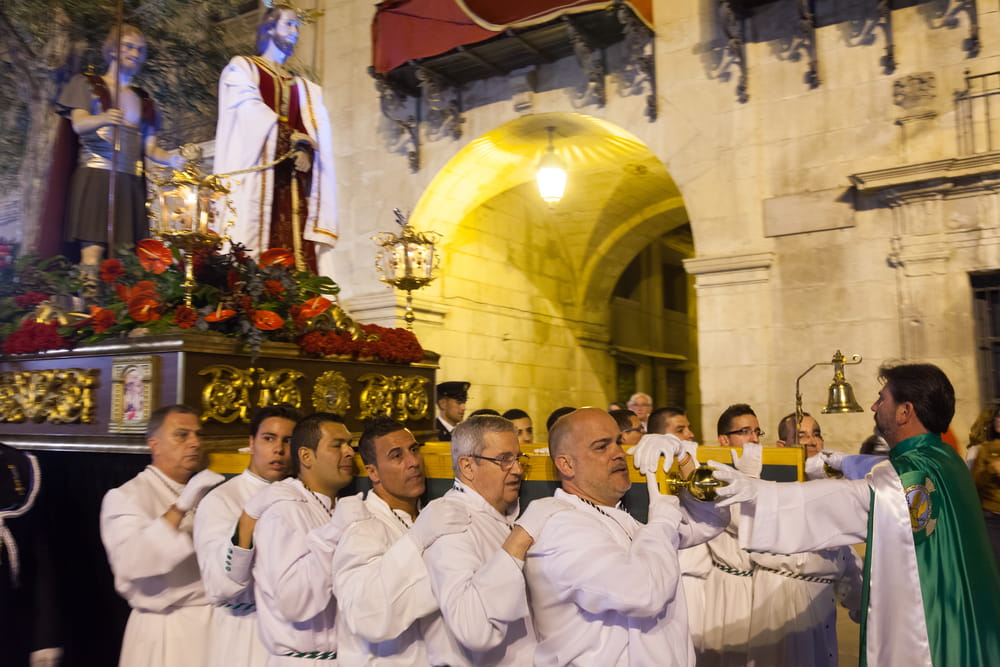
- When: from March 29 to April 5, 2026, from Palm Sunday to Easter Sunday.
- What makes Semana Santa in Alicante special: it combines religious tradition, urban atmosphere and Mediterranean character.
- What to see first: La Burrita on Palm Sunday, the processions in Santa Cruz on Holy Wednesday, Santo Entierro on Good Friday, and Encuentro on Easter Sunday.
- How much it costs: most street processions can be watched for free. Extra costs usually include grandstand seating, transport, cafes and private tours.
- What to keep in mind: the city center gets crowded, some streets are closed, and it is best to double-check exact routes and times in the official El Capuchino program the day before.
Contents:
- Semana Santa in Alicante – what you need to know
- The history of Semana Santa in Alicante
- Semana Santa 2026 in Alicante – key dates
- Where to watch the processions
- What people do and eat at Easter in Spain
- Where to stay so you can see it all
- FAQ
Semana Santa 2026 in Alicante – what you need to know
Semana Santa in Alicante is one of the most important spring celebrations on the Costa Blanca. It does not feel like a museum set: the processions move through a living city, along the streets of the old center, close to the sea, under the Mediterranean sun, which gives the whole atmosphere an especially cinematic quality by evening.
In 2026, 27 hermandades and cofradías will take to the streets of Alicante. That is why the program is so full – from the family-friendly and bright La Burrita on Palm Sunday to the solemn Santo Entierro on Good Friday and the joyful Encuentro on Easter Sunday.
For visitors, it is a great way to discover the city: in a single route, you can experience religious tradition, local neighborhoods, music, the visual beauty of the processions and Easter gastronomy.
You may also like our Alicante Travel Guide: Everything You Need to Know About the City and Region
✨Club Alegría
Sign up for our club and enjoy its benefits:✔10% exclusive discount
✔Complimentary water
✔Check-out at 1:00 PM
✔Early check-in at 2:00 PM
The history of Semana Santa in Alicante
The history of Semana Santa in Alicante goes back at least to the beginning of the 17th century. The first written reference dates to 1600, although the celebration itself is likely even older. This is an important detail: Alicante does not simply have a beautiful Holy Week, but a tradition that has been shaped over centuries.
Over time, Alicante’s Semana Santa developed its own character – more maritime, southern and Mediterranean than in many inland cities of Spain. Here, the connection between religious solemnity, the fabric of the old quarters and the open space by the sea is especially clear.
Since 2022, Semana Santa in Alicante has held the status of Fiesta de Interés Turístico Nacional. This recognition reflects not only the artistic value of the processions, but also the collective effort invested every year by the brotherhoods, musicians, volunteers and local residents.
Semana Santa 2026 in Alicante: Full program
Events before Holy Week
If you are in Alicante before Palm Sunday, you will notice that Semana Santa does not begin all at once. The city gradually prepares for it through preliminary acts, musical events and ceremonial gatherings that set the tone for the whole week.
Palm Sunday: March 29
Processions:
- Jesús Triunfante, ‘La Burrita’: departs at 11:30 from Diputación. Route: Luceros, Alfonso El Sabio, Rambla, Explanada, Plaza del Mar, Pórtico and Ayuntamiento.
- Oración en el Huerto: departs at 11:30 from Basílica de Santa María. Route: Mayor, Muñoz, Abad Penalva, Labradores, San Cristóbal, Mestre Martínez, Rambla, Mayor, Villavieja and Plaza de Santa María.
- Verónica: departs at 12:15 from Basílica. Route: Mayor, Muñoz, Abad Penalva, Labradores, M. Martínez, Rambla, Mayor, Villavieja and Santa María.
- San Pedro Apóstol: departs at 18:00 from Basílica. Route: Villavieja, Santísima Faz, Mayor, Abad Penalva, San Cristóbal, Rambla, Mayor, Stma. Faz, Villavieja and Santa María.
- Hallazgo: departs at 19:00 from convento de Capuchinas. Route: Cándida, Susana Llaneras, Alfonso El Sabio, Constitución, Rambla, Mayor, Abad Penalva, Concatedral, Labradores, San Cristóbal, Primo de Rivera and San Vicente.
- Gran Poder: departs at 18:50 from parroquia de la Misericordia. Route: Cuesta Fábrica, Misericordia, Trafalgar, Concepción, Calderón, López Torregrosa, Rambla, Miguel Soler, Concatedral, Labradores, San Cristóbal, Concepción and Díez Moreu.
- Santa Flagelación: departs at 18:00 from calle Jaén. Route: Soto Ameno, Santa Felicitas, Pintor Gisbert, Tucumán, General Marvá, Quintana, Pablo Iglesias, Alfonso El Sabio, Navas, Teatro, Duque Zaragoza, Rambla, Mayor, Muñoz, Abad Penalva and Concatedral.
March 30, 2026 – Holy Monday
Monday in Alicante feels more intimate, but also very expressive. It is the day when you can feel the transition from the family-friendly mood of Palm Sunday to the more solemn and contemplative part of the week.
- Humildad y Paciencia: departs at 18:45 from Parroquia de Nª Señora de Gracia. Route: Ángel Lozono, Teatro, Constitución, D. Zaragoza, Rambla, Mayor, Muñoz, Concatedral, Abad Penalva, Muñoz, Mayor, Portal de Elche, San Francisco, Castaños, Barón de Finestrat, Jerusalén and Colón.
- ‘El Morenet’: departs at 18:00 from Ermita Virgen del Socorro. Route: Madrid, Virgen del Socorro, Jorge Juan, 2º Pórtico, Muñoz, San Nicolás, San Cristóbal, Rambla, Explanada, Puerta del Mar, Paseo de Gómez, Pasarela, Virgen del Socorro and Ermita.
- Prendimiento: departs at 17:45 from MARQ. Route: Dr. Sapena, San Carlos, Adolfo Blanch, Sevilla, Hospital Viejo, Santa Teresa, Plaza de España, Calderón, Alfonso El Sabio, López Torregrosa, Rambla, Altamira and Ayuntamiento.
- Jesús Despojado: departs at 19:00 from Ermita de San Roque. Route: Lepanto, Toledo, San Agustín, Convento, Virgen del Remedio, Stma. Faz, San Nicolás, Labradores, Primo de Rivera, Sorolla, Rambla, Mayor, Muñoz and Abad Penalva.
March 31, 2026 – Holy Tuesday
- Ecce-Homo: departs at 18:20 from San Antonio de Padua. Route: Carmelo Calvo, Gutiérrez Petén, Quintana, Segarra, Alfonso El Sabio, Castaños, Ruperto Chapí, D. Zaragoza, Rambla, Portal de Elche, Bailén, Gerona, Bazán, Alfonso El Sabio, Gutiérrez Petén and Carmelo Calvo.
- Stabat Mater: departs at 20:00 from Nª Señora de Gracia. Route: Montañeta, Teatro, Bazán, D. Zaragoza, Rambla, Mayor, Muñoz, Stma. Faz, Lonja Caballeros, Jorge Juan and Ayuntamiento.
- Cristo del Mar: departs at 19:30 from Santa María. Route: Villavieja, Mayor, Lonja Caballeros, Monjas, San Agustín, Montengón, Labradores, San Cristóbal, Pintor Sorolla, López Torregrosa, Rambla, Mayor, Concatedral, San Nicolás, San Agustín, Stma. Faz and Villavieja.
- Nuestro Padre Jesús: departs at 21:00 from San Nicolás. Route: Stma. Faz, Montengón, Labradores, Primo de Rivera, Rambla, Mayor and entrance into Concatedral.
April 1, 2026 – Holy Wednesday
Holy Wednesday is one of the most photogenic and emotional days of Semana Santa in Alicante. The main highlights are La Marinera and the processions in Santa Cruz, where the pasos move through the steep and narrow streets of the old quarter.
- Divino Amor y ‘La Marinera’: departs at 18:30 from Convento de la Sangre. Route: Virgen del Belén, San Cristóbal, Primo de Rivera, Rambla, Pintor Sorolla, López Torregrosa, Rambla, Mayor, Stma. Faz, San Agustín and Monjas.
- Bajada y subida de Santa Cruz: departs at 19:00 from Ermita de Santa Cruz. Route: Diputado Ausset, San Antonio, San Rafael, Cienfuegos, Santos Médicos, San Cristóbal, Rambla, Mayor, Abad Penalva, San Nicolás, Labradores, Argensola, Carmen, San Rafael, San Antonio and Diputado Ausset.
You may also be interested in Alicante’s Top Sights: What to See and Why This City Is Truly Special
April 2, 2026 – Maundy Thursday
Thursday is especially packed with events.
- Santa Redención: departs at 19:30 from San Antonio de Padua. Route: Gutiérrez Petén, Campos Vasallos, Quintana, Segarra, Alfonso El Sabio, Ruperto Chapí, D. Zaragoza, Rambla, Portal de Elche, Bailén, Gerona, Teatro, Constitución, Castaños, Segarra and Gutiérrez Petén.
- Santa Cena: departs at 20:00 from Maria Auxiliadora. Route: Ferré Vidiella, San Juan Bosco, Marvá, Luceros, Alfonso El Sabio, Mercado, Constitución, Rambla and Portal de Elche.
- Piedad y Caridad y Cristo de la Paz: departs at 20:30 from San Juan Bautista. Route: Foglietti, Oscar Esplá, Reyes Católicos, Calvo Sotelo, Montañeta, Teatro, Ruperto Chapí, Rambla, Altamira and Ayuntamiento.
- Perdón: departs at 22:45 from San Nicolás. Route: Abad Penalva, San Cristóbal, Rambla, Alfonso El Sabio, Constitución, Mayor, Muñoz and Abad Penalba.
- Buena Muerte (Procesión del Silencio): departs at 23:30 from San Nicolás. Route: San Nicolás, Virgen del Belén, San Cristóbal, Sorolla, López Torregrosa, Rambla, Mayor and Muñoz.
April 3, 2026 – Good Friday
Good Friday is the most solemn day of the week. The program highlights La Sentencia, Mater Desolata, Santo Sepulcro and La Soledad. Many people consider it the emotional peak of the entire Semana Santa.
If you want to see the most solemn and focused side of Alicante’s Easter tradition, Good Friday and the Santo Entierro processions are the best choice.
- Sentencia de Jesús: departs at 10:15 from Inmaculada del Plá. Route: Haroldo Parres, Gonzalo Mengual, Padre Esplá, Pío XII, Suárez Llanos, Adolfo Blanch, Hospital Viejo, Santa Teresa, Plaza de España, Calderón, Alfonso El Sabio, López Torregrosa, Rambla, Altamira and Ayuntamiento.
- Mater Desolata: departs at 17:45 from San José de Carolinas. Route: Garbinet, Viravens, San Carlos, Sevilla, Hospital Viejo, Misericordia, Díaz Moreu, San Vicente, Alfonso El Sabio, López Torregrosa, Rambla, Mayor, Muñoz and Concatedral.
- Santo Sepulcro: departs at 20:45 from San Nicolás. Route: San Cristóbal, Primo de Rivera, Alfonso El Sabio, López Torregrosa, Rambla, Mayor, Muñoz and Concatedral.
- Soledad de Santa María: departs at 20:30 from Santa María. Route: Stma. Faz, Mayor, Abad Penalva, San Cristóbal, Primo de Rivera, Alfonso El Sabio, López Torregrosa, Stma. Faz, Mayor, Villavieja and Santa María.
April 4, 2026 – Holy Saturday
Holy Saturday in Alicante is quieter, but not empty. According to the official program, in the morning there is a moving traslado of Virgen de la Alegría from Convento de las Monjas de la Sangre to Basílica de Santa María. It is a more intimate moment that often stays in memory no less than the major processions.
April 5, 2026 – Easter Sunday
Easter Sunday is the brightest and most joyful part of Semana Santa. The day’s program includes El Resucitado and Nuestra Señora de la Alegría. The key moment is the Encuentro at Plaza del Ayuntamiento at 12:00.
This is when aleluyas are showered over the square from balconies and windows, and the atmosphere changes completely – from the solemnity of Holy Week to open Easter celebration. For a first trip to Alicante, it is one of the best possible finales to Semana Santa.
- Cristo Resucitado: the first brotherhood departs at 10:45 from San Nicolás. Route: Abad Penalva, San Nicolás, Mayor, 2º Pórtico, Pórtico Audiencia, Cervantes, Plaza del Mar, Explanada, Rambla, Miguel Soler and Concatedral.
- Virgen de la Alegría: departs at 11:30 from Santa María. Route: Jorge Juan, Pórtico Audiencia, Cervantes, Plaza del Mar, Explanada, Rambla, San José and Concatedral.
- Encuentro between Nuestra Señora de la Alegría and Cristo Resucitado: 12:00, Plaza del Ayuntamiento.
Where to watch the processions
Explanada and the city center are a good option for a first introduction. It is easier to navigate here, combine a walk with watching the processions, and enjoy a more open atmosphere.
Casco Antiguo is the best choice if you want to feel the old soul of Alicante. Here, Semana Santa feels more intense and more intimate than on the wider avenues.
Santa Cruz is a must for those who love photography and the dramatic movement of the pasos.
Plaza del Ayuntamiento is the key location for Easter Sunday and the Encuentro.
Here you will find the full program in Spanish.
What people do and eat at Easter in Spain
In Spain, Easter is not only about processions. For many families, it is a time for gatherings, church services, walks, visits to relatives and a general spring reset. Even people who do not take part in the religious side of the celebration often go to watch the processions as an important part of urban culture.
In gastronomic terms, Semana Santa and Pascua in Alicante are associated with meat-free dishes, fish, soups and sweets. On the table you will often find mona de Pascua, buñuelos and torrijas.
Where to stay so you can see it all
If you are planning to watch several processions, the most convenient option is to stay not too far from the center, but also not right inside the busiest streets. During Semana Santa, this matters even more: some routes are closed, the center gets crowded, and moving between the main highlights often means a lot of walking.
For this kind of trip, Alicante Smart Hotel is a very practical option. The hotel is located about 15 minutes on foot from the center, 20 minutes from Playa del Postiguet, 5 minutes from Plaza de Toros Alicante and about 10 minutes from Castillo Santa Barbara. It is a convenient base if you want to catch both daytime and evening processions and return to your room between them without long transfers.
Another advantage is the accommodation format itself. The rooms are equipped with a kitchen, private bathroom, Wi-Fi, air conditioning, refrigerator, microwave and Nespresso coffee machine. For a short Easter trip, this is especially convenient: you can have breakfast before an early departure, rest between processions and not depend entirely on cafe opening hours in the center.
- Location: convenient access to the center, Casco Antiguo, Santa Cruz and Plaza del Ayuntamiento.
- Practical format: modern rooms with a kitchen and everything you need for a short city stay.
- For Semana Santa: you can make it to both morning and evening processions without complicated logistics.
- Direct booking: 10% discount, and for stays of 7 nights or more – 15% on request.
- Pool and additional services for your comfort.
Choose your room type:
Single Room for solo travelers,
Superior Double Standard for couples,
Superior Room with Terrace for guests who would like a little more private outdoor space,
and Superior Triple Room for friends or small families traveling together on the Costa Blanca.
See all accommodation options:
FAQ
What can I do during Holy Week?
During Holy Week in Alicante, you can watch the main processions, walk through the old town, visit Santa Cruz, enjoy local Easter sweets, spend time by the sea, and experience one of the city’s most important cultural and religious traditions.
Are things open in Spain during Holy Week?
Yes, many places stay open during Holy Week in Spain, especially in tourist cities like Alicante. Restaurants, cafes and many shops usually operate, although some businesses may have reduced hours on the main feast days such as Holy Thursday and Good Friday.
What do they do for Holy Week in Spain?
In Spain, Holy Week is marked by processions, religious services, family gatherings, traditional food and time spent outdoors. Even people who are not especially religious often go out to watch the processions because they are such an important part of local culture.
Where to spend Holy Week in Spain?
Some of the best-known places to spend Holy Week in Spain are Seville, Malaga, Valladolid, Zamora and Alicante. Alicante is a particularly good choice if you want a combination of Mediterranean weather, sea views, historic streets and impressive processions.
What are not allowed to do during Holy Week?
There are no general restrictions for visitors, but it is important to behave respectfully during processions and religious events. In practice, that means avoiding disruptive behavior, not blocking the route, and keeping noise to a minimum in the most solemn moments.
What activities can you do for Easter?
At Easter in Alicante, you can watch the Encuentro on Easter Sunday, enjoy spring walks by the sea, discover the city’s neighborhoods, try traditional sweets such as mona de Pascua and torrijas, and combine cultural plans with beach time if the weather is good.
What to do in Alicante in April?
April is a great month to explore Alicante. You can attend Holy Week events, visit the old town, go up to Castillo de Santa Bárbara, walk along the Explanada, relax at Playa del Postiguet, enjoy local gastronomy and take short trips along the Costa Blanca.
What do people do on Easter in Spain?
On Easter in Spain, people attend religious celebrations, watch joyful Resurrection processions, meet family and enjoy long spring weekends. In Alicante, one of the most memorable Easter moments is the Encuentro in Plaza del Ayuntamiento.
Where is the best place to spend Easter in Spain?
The best place depends on the kind of experience you want. Alicante is one of the best options if you are looking for Easter by the sea, a walkable city center, beautiful processions and pleasant spring weather all in one trip.
What are some Easter activities for adults?
For adults, Easter in Alicante can include watching evening processions, enjoying local food and wine, exploring museums and historic streets, taking scenic walks, visiting nearby beaches and planning a relaxed spring city break with a strong cultural atmosphere.