
TL;DR:
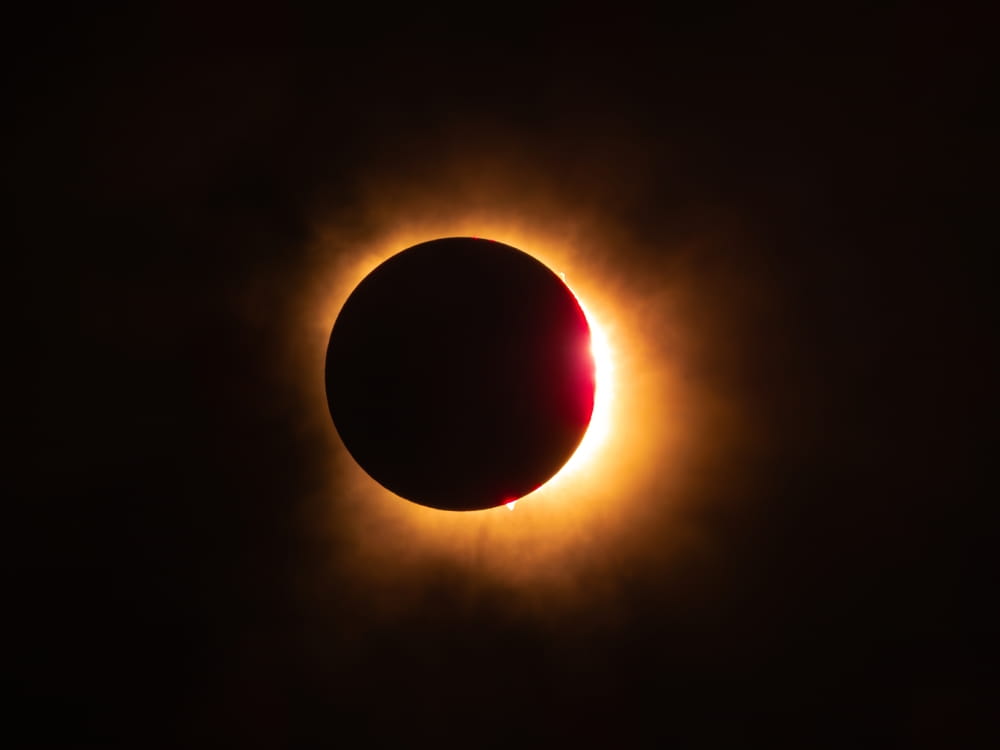
- On 12 August 2026, Alicante will experience an almost total solar eclipse: at maximum, the Moon will cover 99.14% of the solar disc.
- Near the University of Alicante, the partial phase is expected to begin at around 19:40, reach maximum at approximately 20:34, and continue until sunset at 20:59.
- Alicante province is outside the path of totality. Even so, the remaining solar crescent will be extremely thin, daylight will change noticeably, and the eclipse will be one of the major events of the summer.
- The key to a successful viewing experience is an unobstructed view towards the western horizon: the eclipse will take place shortly before sunset, when the Sun is very low in the sky.
- Look at the Sun only through certified eclipse glasses meeting the ISO 12312-2 standard. Ordinary sunglasses, film, discs and tinted glass do not protect your eyes.
- The safest and most organised option is the University of Alicante’s free public observation event in San Vicente del Raspeig.
- Alicante Smart Hotel makes it easy to combine this rare astronomical event with a beach break and time in central Alicante.
Solar Eclipse in Alicante on 12 August 2026: Where to Watch and How to Prepare
On the evening of 12 August 2026, residents and visitors in Alicante will be able to witness one of the most eagerly awaited astronomical events in recent years. The path of the total solar eclipse will cross northern Spain and part of the Valencian Community, while in Alicante the Moon will cover 99.14% of the solar disc.
Alicante will not experience totality, so the solar corona will not become visible and eclipse glasses must not be removed. Nevertheless, the eclipse will be exceptionally deep: only an extremely thin, bright crescent of the Sun will remain, natural light will change noticeably, and the climax will occur in the evening shortly before sunset over the Mediterranean.
Alicante is an attractive choice for travellers who want to turn the eclipse into a complete city break: spend the day at the beach, choose an open location with a clear view to the west, and return to the city centre afterwards without a long night-time drive from a remote viewing site.
Important: 99.14% coverage is an extremely deep partial eclipse, but it is not totality. Even a narrow solar crescent can permanently damage your eyesight. In Alicante, certified eye protection will be required throughout the entire visible eclipse.
What will happen on 12 August 2026
A solar eclipse occurs when the Moon passes between the Earth and the Sun and covers the solar disc. Inside the narrow path of the Moon’s shadow, observers experience a total eclipse, during which the Sun is completely hidden for a short time. Outside that path, the eclipse remains partial.
In 2026, the Moon’s shadow will move across Spain from the north-west towards the Mediterranean. Totality will be visible in parts of Castellón and Valencia provinces. Alicante province lies south of the path of totality, although the percentage of the Sun covered here will still be exceptionally high.
The official Generalitat Valenciana portal describes the Valencian Community as one of the best-positioned regions for observing the eclipse. The regional authorities have created a dedicated information website, identified preliminary official viewing locations and developed a coordinated multi-agency safety plan.
You can check the official map, recommendations and updates on the Eclipses Comunitat Valenciana website.
What the solar eclipse will look like in Alicante
According to the event information published on the official Generalitat Valenciana portal in cooperation with the University of Alicante, the estimated timings for the campus in San Vicente del Raspeig are:
- partial eclipse begins: around 19:40;
- maximum eclipse: around 20:34;
- coverage of the solar disc: 99.14%;
- sunset: around 20:59;
- astronomical end of the eclipse: around 21:25, when the Sun will already be below the horizon in Alicante.
This means that almost the entire part of the eclipse visible from Alicante will take place during the final 80 minutes before sunset. Maximum coverage will occur roughly 25 minutes before the Sun disappears below the horizon.
At maximum, less than 1% of the solar disc will remain visible. That small area will still emit enough light to damage the retina. Unlike locations inside the path of totality, Alicante will have no safe moment for looking directly at the Sun without specialist eclipse glasses.
What you may see at maximum eclipse
In favourable weather, observers will see an extremely thin crescent of sunlight. The surrounding light may become unusually dim and cool in tone, shadows may appear sharper, and the air temperature may fall slightly. Birds and insects may also change their behaviour in response to the rapid reduction in daylight.
The city will not become as dark as areas inside the path of totality, and the solar corona will not be visible. Alicante’s main spectacle will be the almost completely covered Sun against the evening sky and the gradual transformation of the light before sunset.
🌘 Come to Alicante for the solar eclipse
Combine one of the biggest astronomical events of 2026 with a Mediterranean break.
✔99.14% coverage of the solar disc
✔Central hotel location
✔Easy access to beaches, TRAM services and city viewpoints
✔A comfortable room after one of the most memorable astronomical events in years
Why watch the eclipse in Alicante
An exceptionally deep eclipse without travelling to a remote location
To experience totality, you must be inside the relatively narrow total-eclipse path. Popular sites in Castellón and Valencia provinces are expected to attract very large crowds. For example, the official preventive plan estimates that up to 60,000 people may gather on Castellón’s beaches and around 10,000 at an official viewing site in Valencia.
Alicante offers 99.14% coverage without joining the mass movement of vehicles towards the busiest observation areas. This may appeal to travellers who prefer to stay in the city and choose an accessible location with a clear western horizon in advance.
The difference between a 99.14% partial eclipse and totality is fundamental from a scientific and visual perspective. For a city break, however, Alicante offers a compelling combination: an exceptionally deep eclipse, the Mediterranean coast, full urban infrastructure and the option to avoid the most crowded viewing zones.
City services and facilities close at hand
You do not need to travel into mountainous or difficult terrain. Alicante and its surrounding area offer beaches, elevated locations and open spaces, while public transport, restaurants, shops and medical facilities remain nearby.
The University of Alicante will also host a free public observation event with specialists and equipment designed for safe solar viewing.
Combine the eclipse with a beach holiday
The event falls at the height of summer. You can spend the day at the beach, explore the old town or visit local attractions before travelling to your pre-selected viewing point in the evening.
For ideas, see Summer in Alicante: Beaches, Events and Things to Do and our Alicante travel guide.
Stay for a few days
August has much more to offer than the eclipse. You can add evening walks, guided tours, concerts and day trips to your itinerary. Although the Perseid meteor shower also peaks around these dates, the bright near-full Moon in 2026 may make fainter meteors difficult to see. You should not expect ideal Perseid conditions immediately after the eclipse, although the brightest meteors may still be visible under clear skies.
Best places in Alicante to watch the eclipse
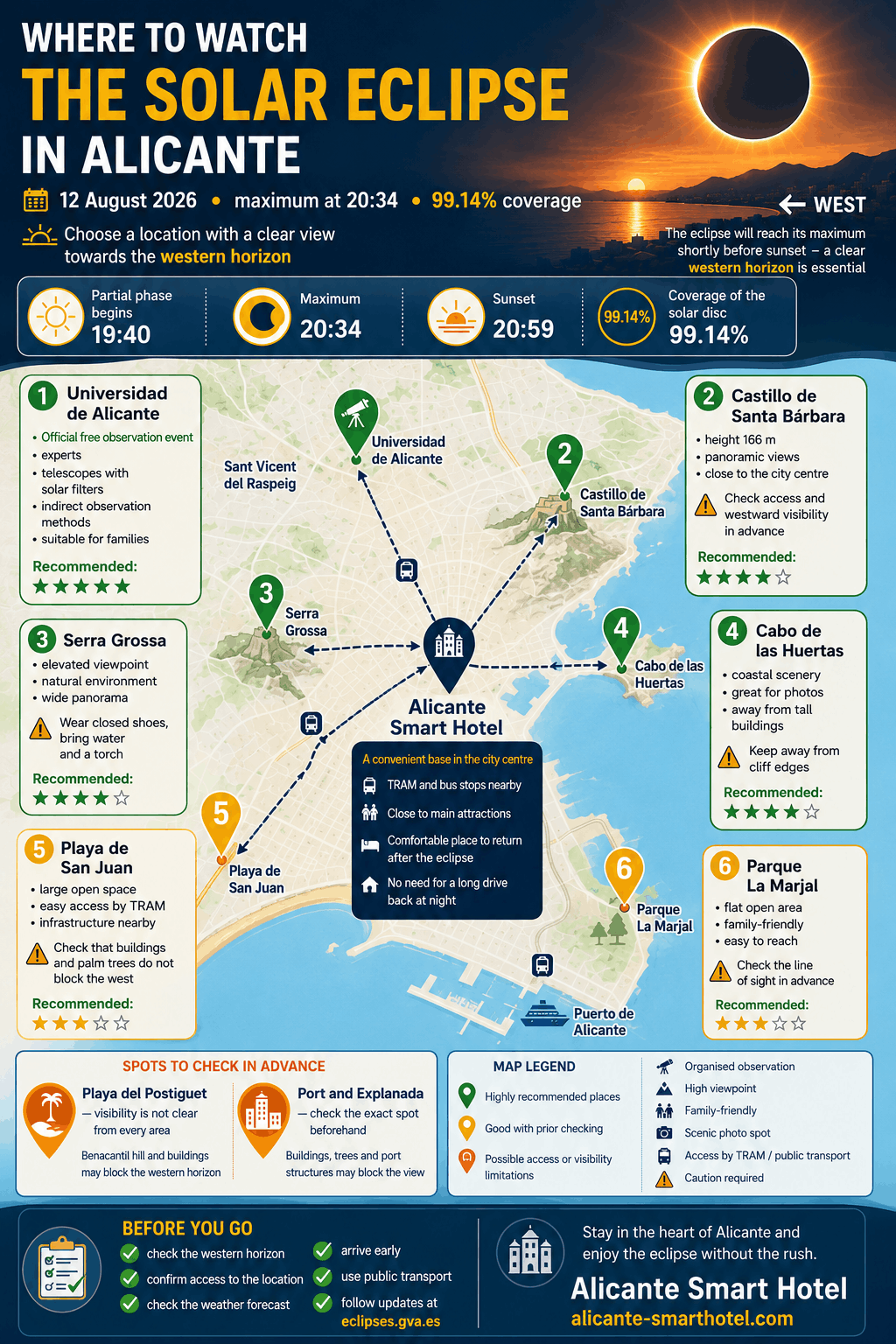
The main criterion is not simply proximity to the sea, but an unobstructed view towards the west. The Sun will be very low, so even a building, hill or mountain can block the maximum phase.
The official Generalitat website recommends checking your chosen point beforehand using ShadeMap and the national IGN eclipse visualiser. It is also sensible to visit the location in person on an evening before 12 August to confirm that the western horizon is genuinely clear.
1. University of Alicante – the safest organised option
Where: the western side of the University of Alicante campus in San Vicente del Raspeig, near the Science Park and the university institutes building.
The University of Alicante and the Astroingeo University Astronomy Association are organising a free public observation event. The site is expected to operate on 12 August from approximately 19:15 until the end of the visible part of the eclipse.
Organisers plan to use indirect viewing methods and telescopes fitted with solar filters. The presence of specialists makes the campus a particularly suitable choice for families, first-time observers and anyone without certified viewing equipment of their own.
Safe observation methods are expected to include:
- indirect projection of the solar image;
- viewing through telescopes fitted with professional solar filters;
- guidance from specialists explaining each phase of the eclipse;
- clear eye-safety instructions.
As the event is free and open to the public, high attendance is likely. Check in advance whether registration is required, whether capacity restrictions have been introduced and how access to the campus will be managed.
Practical advice: do not plan to arrive at maximum eclipse. Aim to be at the site no later than 18:45–19:00 unless the organisers publish different guidance.
- Advantages: expert guidance, safe equipment, open viewing area and free entry.
- Potential drawback: high attendance is likely, so allow plenty of extra time.
- official event information
- view on the map
2. Santa Bárbara Castle
The castle stands on top of Mount Benacantil at an altitude of 166 metres and offers one of the widest panoramas in the city. Summer opening hours normally extend into the evening, but access arrangements, events and capacity limits for 12 August should be checked shortly before your visit.
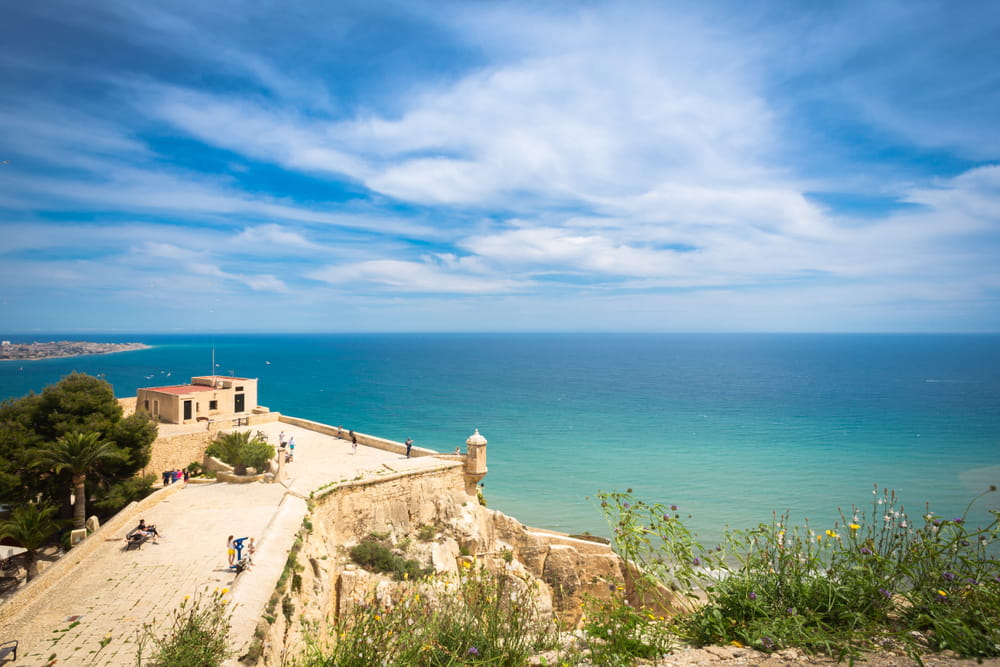
Photo: Civil/Shutterstock.com
Choose a section of the castle with a clear view towards the western horizon. Not every terrace will be equally suitable, as walls and parts of the terrain may block the low Sun.
- Advantages: elevation, panoramic views and a central location.
- Bear in mind: there is no visitor parking at the castle, and private vehicle access is restricted.
- Recommendation: do not rely on a last-minute visit; confirm access and opening arrangements in advance.
- official visitor information
- view on the map
3. Serra Grossa
Serra Grossa is a natural area covering more than 80 hectares at Alicante’s northern entrance. Elevated sections may provide a good view, but the exact spot should be selected according to the direction of the slope.
- Advantages: elevation, a natural setting and broad panoramas.
- Bear in mind: uneven ground, summer heat, limited lighting on some paths and increased wildfire risk.
- Bring: closed footwear, water, a fully charged phone and a torch; plan your return carefully around nightfall.
- route information
- view on the map
4. Cabo de las Huertas
The rocky coastline of Cabo de las Huertas can be a beautiful setting for photography and a quiet evening by the sea. However, different stretches face different directions, and views towards the west may be obstructed by terrain, buildings or the headland itself.
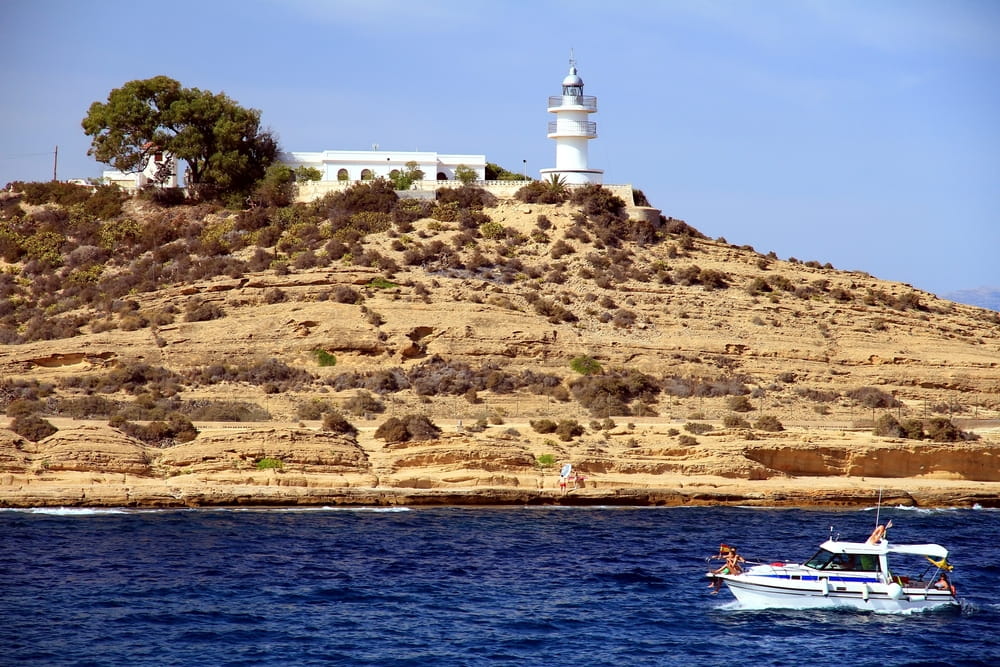
Choose a safe, open point with a genuine view to the west. Stay away from cliff edges and do not descend into hard-to-access areas.
- Advantages: coastal scenery, a natural atmosphere and fewer large buildings.
- Bear in mind: rocky surfaces, limited lighting and a potentially difficult return after sunset.
- view on the map
5. San Juan Beach and nearby open spaces
San Juan Beach offers a long coastline and extensive visitor facilities. However, the beach faces mainly towards the sea, while the Sun will set over land to the west, so not every point on the sand will have an unobstructed view.
Before travelling, check whether buildings, palm trees or other urban structures block the western horizon. In some cases, an open square or wide junction slightly inland may offer a better view than the water’s edge.
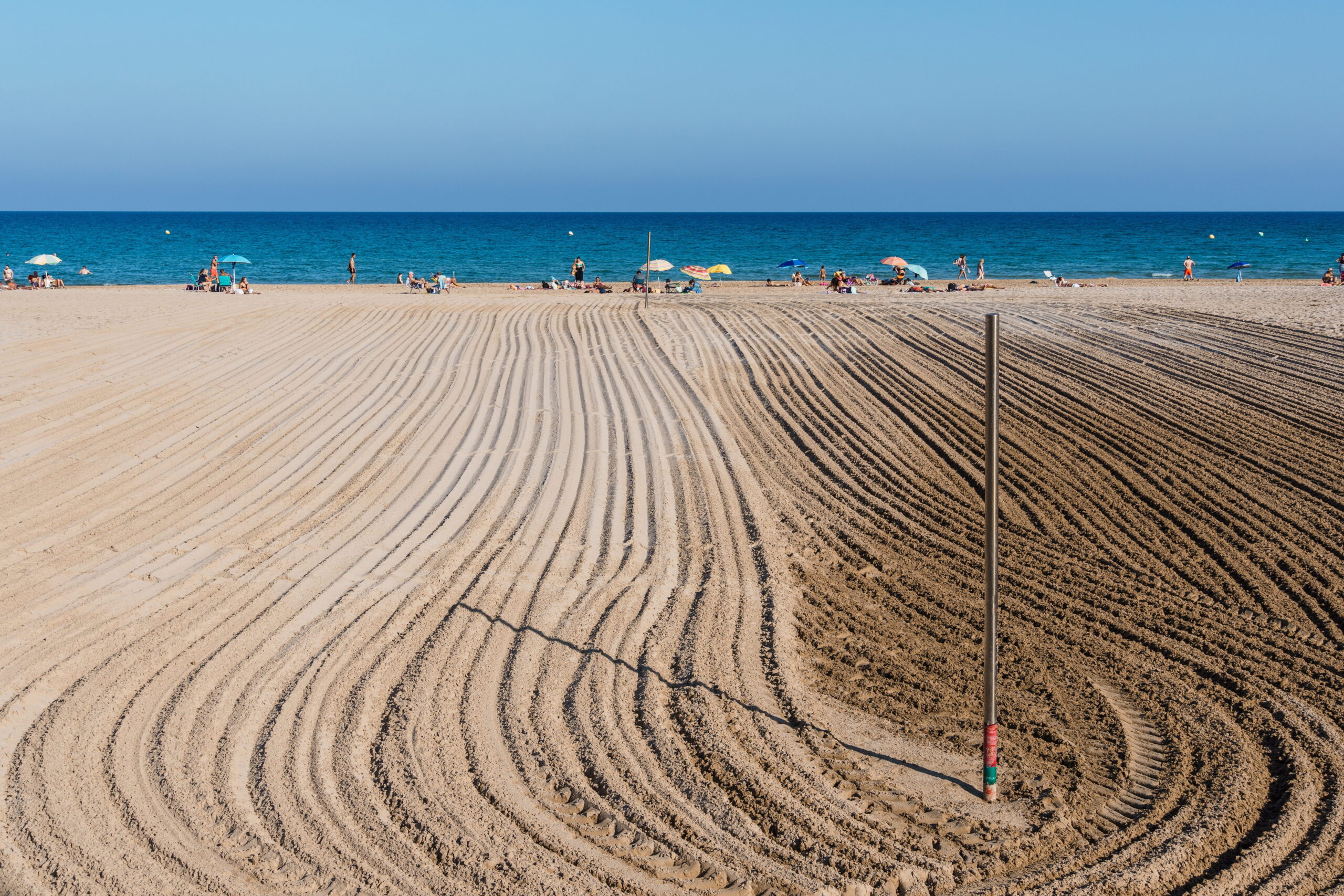
Photo: JJFarq/Shutterstock.com
- Advantages: open space, TRAM connections, restaurants and nearby services.
- Bear in mind: crowds and obstructions on the western horizon are possible.
- view on the map
6. La Marjal Park and other open urban spaces
Large parks may be more suitable than narrow streets and seafront promenades, provided there are no tall buildings or trees to the west. La Marjal Park offers broad open areas, although you should still check the exact line of sight beforehand.
- Advantages: accessibility, level ground and suitability for families.
- Bear in mind: trees and urban structures may still block the low Sun.
- view on the map
Are Postiguet Beach, the Explanada and the port suitable?
These locations are close to the city centre, but they should not automatically be considered the best viewing points. Postiguet Beach faces south-east, while the view to the west is partly obstructed by urban development and Mount Benacantil. On the Explanada and in the port, buildings, trees, structures and vessels may also block the low Sun.
Use these locations only after checking the exact spot in advance. The essential rule remains the same: at maximum eclipse at 20:34, you must have an unobstructed view towards the very low western horizon.
How to watch the solar eclipse safely
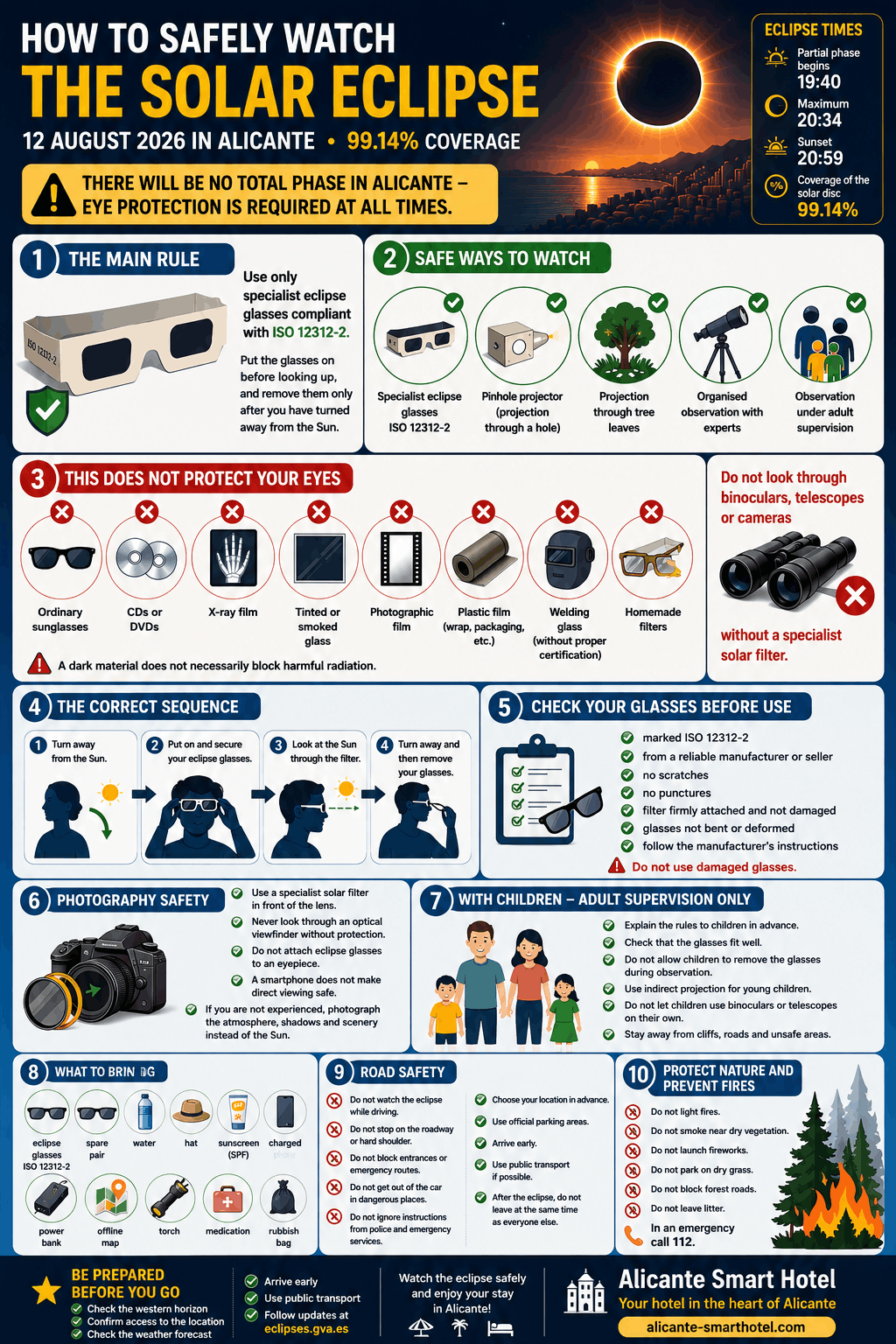
Looking at the Sun without proper protection can cause photochemical or thermal damage to the retina. The danger is that the retina has no pain receptors: you may not feel the injury while it is happening, and symptoms can appear later.
Possible consequences include a dark spot in the centre of your vision, distorted images, reduced visual acuity and permanent eye damage.
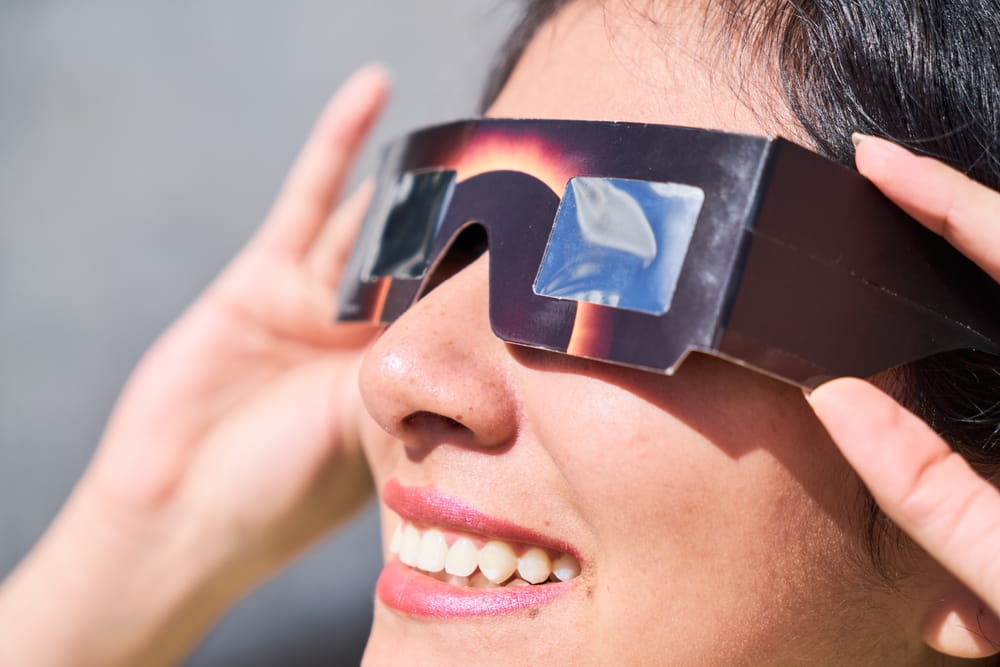
Use only certified ISO 12312-2 eclipse glasses
Direct viewing requires specialist solar-eclipse glasses that comply with the ISO 12312-2 standard. The product or packaging should carry the appropriate marking, and the seller and manufacturer should provide clear contact information.
Before use:
- inspect the filter in good light;
- check for scratches, punctures and worn areas;
- do not use bent or damaged glasses;
- read the manufacturer’s instructions;
- help children put the glasses on correctly before they look up.
How to look at the Sun correctly
- Turn away from the Sun.
- Put on your eclipse glasses and make sure they completely cover your eyes.
- Only then turn towards the Sun.
- After viewing, turn away first and remove the glasses only afterwards.
Do not remove your eye protection while looking at the Sun. In Alicante, eclipse glasses are required throughout every visible phase because there will be no total phase.
What not to use as a substitute
- ordinary sunglasses, regardless of how dark they are;
- several pairs of sunglasses worn together;
- X-ray film;
- CDs or DVDs;
- exposed photographic film;
- photocopying, packaging or plastic film;
- smoked glass;
- welding glass without confirmed suitable certification;
- any homemade filter.
A material that appears dark does not necessarily block dangerous ultraviolet and infrared radiation.
Safe indirect viewing methods
You can observe the eclipse without looking directly at the Sun. One of the simplest options is a pinhole projector, which projects the solar image through a small opening onto a white surface.
You may also see crescent-shaped patches of light beneath trees: gaps between leaves act as natural pinhole cameras and project the shape of the partially covered Sun onto the ground.
When using an indirect method, never look through the opening towards the Sun. Look only at the projected image.
How to watch the eclipse safely with children
An almost total solar eclipse can be a memorable educational experience, but children must remain under constant adult supervision.
- Explain beforehand that they must never look at the Sun without eclipse glasses, even for a second.
- Make sure the glasses fit properly and do not slip off.
- For younger children, use indirect projection instead of direct viewing.
- Do not allow children to use binoculars, telescopes or cameras on their own.
- Keep children supervised in crowds, near cliffs, at viewpoints and on nature trails.
- Provide a hat, sunscreen and enough water.
The official preventive plan specifically considers risks associated with missing children and high crowd density. For families, the organised University of Alicante event or a level, open urban space without cliffs or difficult access routes may be the most practical choice.
How to photograph the solar eclipse
A smartphone or camera does not make looking at the Sun safe. Never view the eclipse through an unprotected optical viewfinder, and remember that pointing an unfiltered lens at the Sun can damage the camera sensor.
Cameras and telescopes need a separate solar filter
The filter must be installed in front of the lens, on the side of the equipment facing the Sun. A filter placed at the eyepiece does not provide sufficient protection because sunlight has already been concentrated inside the instrument.
Never point the following at the Sun without a suitable solar filter:
- a still camera;
- a video camera;
- a telescope;
- binoculars;
- a spotting scope;
- a long telephoto lens.
Do not hold ordinary eclipse glasses in front of a binocular or telescope eyepiece. Concentrated sunlight can damage both the filter and your eyes almost instantly.
Prepare in advance
- test your equipment before 12 August;
- practise attaching the filter;
- use a tripod;
- prepare a spare battery and memory card;
- do not remove or change the filter while the equipment is aimed at the Sun;
- do not allow members of the public to look through your equipment without supervision.
Anyone without experience in solar photography may be better off photographing the atmosphere around the event: changes in light, unusual shadows, people’s reactions and the evening landscape.
🏨 Stay in central Alicante
There is no need for a long journey after the eclipse. Stay at Alicante Smart Hotel and continue exploring the city the following day.
✔Central Alicante location
✔Easy access to TRAM and bus services
✔Beaches and the old town nearby
✔Air-conditioned rooms with a kitchenette
How the Valencian Community is preparing for the eclipse
The Generalitat Valenciana is treating the event not only as a scientific and tourism opportunity, but also as a major public-safety challenge. A Consell delegated commission has been created to manage the 2026 and 2028 eclipses, together with a dedicated preventive plan.
The coordinated response involves:
- the Valencian Agency for Security and Emergency Response;
- local authorities;
- 112 Comunitat Valenciana;
- the police and Guardia Civil;
- the DGT and road-management services;
- healthcare services;
- fire and forest-fire units;
- Protección Civil;
- transport authorities;
- water-rescue services;
- environmental agencies and SEPRONA;
- scientific and educational organisations.
Risks covered by the plan
The plan addresses not the astronomical event itself, but its possible effects on infrastructure and the public:
- large numbers of visitors;
- traffic congestion near viewing areas;
- illegal parking and blocked emergency routes;
- large numbers of people leaving simultaneously after sunset;
- overloaded mobile networks;
- eye injuries;
- heat-related illness and dehydration;
- missing children;
- wildfires in natural areas;
- unauthorised parking and crowding;
- the need for rapid medical and rescue assistance.
Which services will be reinforced
In the busiest municipalities, the plan provides for preventive command posts, additional police and medical resources, fire crews, Protección Civil volunteers, water-rescue teams and drone surveillance.
The 112 Comunitat Valenciana call centre is expected to increase staffing, while the regional emergency-response system will operate at a heightened level of readiness. Because the eclipse takes place during the high-risk summer wildfire season, particular attention will be given to forest and natural areas.
Specific arrangements may change as the date approaches. Before travelling, consult the official eclipse portal, the Alicante City Council, the University of Alicante, the DGT and local transport operators.
Transport and road safety on 12 August
Even when staying in Alicante, you may encounter heavier traffic across the Valencian Community on the day of the eclipse. The greatest pressure is expected on routes leading towards the path of totality and official observation sites.
The Generalitat advises avoiding unnecessary journeys on the day of the event. Travellers heading to a popular viewing area are encouraged to arrive well in advance — potentially 24–48 hours beforehand — and plan the route carefully.
What not to do
- stop on the carriageway to watch the eclipse;
- park on motorway or intercity-road hard shoulders;
- leave your vehicle in an unsuitable or dangerous location;
- block entrances, fire roads or emergency-service routes;
- stop on bridges, slip roads, junctions or inside tunnels;
- attempt to look at the Sun while driving;
- continue towards an overcrowded site against police instructions.
How to plan your journey
- Choose your viewing location several days in advance, not while driving.
- Check legal parking and the walking route from the car park.
- Use public transport where possible.
- Arrive several hours early, particularly at organised sites.
- Do not assume navigation apps will include every temporary road closure.
- Download an offline map and save your accommodation address.
- Fill up your vehicle in advance.
- Carry water, food and essential medication in case of delays.
- After the eclipse, do not rush to leave at the same time as everyone else.
Why the period after sunset may be particularly difficult
Maximum eclipse will occur shortly before sunset, so thousands of people may begin travelling almost simultaneously. The preventive plan identifies the mass departure after the eclipse as one of the periods with the greatest risk of transport disruption.
Guests staying overnight in Alicante may be better off avoiding a long journey immediately after the event. Wait for traffic to ease, have dinner in the city, and return to your hotel by public transport or on foot when your viewing point is centrally located.
Mobile networks may be unreliable
At major viewing sites, networks may become overloaded around maximum eclipse. Prepare by:
- agreeing on a meeting point with your group;
- taking screenshots of tickets and routes;
- saving the hotel address;
- not relying entirely on messaging apps;
- keeping your phone fully charged.
Environmental protection and wildfire safety
The eclipse falls in August, one of the periods with the highest wildfire risk in the Valencian Community. The regional preventive plan includes increased readiness among forest-fire teams and enhanced monitoring of natural areas.
During the event:
- do not light fires or use naked flames;
- do not discard cigarettes or matches;
- do not use fireworks or pyrotechnics;
- do not use equipment that may create sparks;
- do not block forest roads;
- do not park on dry grass;
- do not camp in unauthorised areas;
- do not leave eclipse glasses, packaging, bottles or other rubbish behind;
- do not damage plants or enter closed areas;
- follow instructions from the police, SEPRONA and environmental authorities.
If you see smoke or fire, move to a safe place and call 112. Do not attempt to tackle a spreading wildfire yourself.
What to bring for eclipse viewing
- certified ISO 12312-2 eclipse glasses and a spare pair;
- enough water for possible delays;
- light snacks;
- a hat;
- sunscreen;
- comfortable closed footwear for natural viewing areas;
- a light layer for the evening;
- essential medication;
- a fully charged phone;
- a power bank and cable;
- an offline map;
- a small torch for the return journey after sunset;
- a bag for your own rubbish;
- a foldable mat or compact chair where permitted.
Do not bring bulky equipment unless you know how to use it safely. At a crowded site, tripods, long lenses and telescopes can create obstructions and increase the risk of injury.
Weather and choosing your final viewing location
Alicante is known for its many sunny days, but climate averages cannot guarantee clear skies on a particular evening. Cloud, haze and local weather conditions may affect visibility.
Start checking the forecast 5–7 days in advance and make the final decision 24–48 hours before the event. Consider not only cloud cover, but also wind, heat, wildfire risk and any official access restrictions.
Carry out a trial visit
Because the Sun will be very low, visit your preferred location beforehand at roughly the same time of day. Make sure there are no:
- buildings;
- mountains or hills;
- dense trees;
- walls or fences;
- advertising structures;
- port installations;
- other obstacles capable of hiding the low Sun.
The official Generalitat website recommends using ShadeMap: if your selected point is in the shadow of a building or terrain at eclipse time, you are unlikely to see the Sun from that location.
Why Alicante Smart Hotel is a convenient base for an eclipse trip
The visible event will continue into the evening, and roads may be congested after sunset. Staying in central Alicante means that this rare astronomical experience does not have to end with a tiring late-night drive.
From Alicante Smart Hotel, guests can conveniently reach central districts, public-transport stops, Santa Bárbara Castle and coastal areas. The University of Alicante campus can be reached by public transport or taxi, although extra travel time should be allowed.
Useful features for guests
- central location;
- access to TRAM services and city buses;
- the option to reach your viewing point in advance without a long-distance journey;
- air conditioning after a hot August day;
- a kitchenette and the essentials for an independent stay;
- the opportunity to remain for a few days and explore Alicante.
The following day, relax on Postiguet Beach or San Juan Beach, explore the old town or take a day trip around the province. You will find ideas in our guide to the Top 15 Places to Visit near Alicante.
✨ Club Alegria
Book your stay directly and enjoy Club Alegria benefits:
✔Exclusive 10% discount
✔Welcome gift: water and coffee capsules
✔Choose either late check-out at 13:00 or early check-in at 14:00, subject to availability
Frequently asked questions about the solar eclipse in Alicante
When will the solar eclipse take place in Alicante?
The eclipse will take place on Wednesday, 12 August 2026. Near the University of Alicante, the partial phase is expected to begin at around 19:40, with maximum eclipse at approximately 20:34.
How much of the Sun will be covered in Alicante?
According to calculations published by the University of Alicante, the Moon will cover 99.14% of the solar disc at maximum eclipse.
Will the eclipse be total in Alicante?
No. Alicante province lies outside the path of totality. The city will experience an exceptionally deep partial solar eclipse.
Can I remove my eclipse glasses at maximum?
No. Because Alicante will not experience totality, certified eclipse glasses must be worn throughout all direct viewing.
What time will the Sun set?
Sunset near the University of Alicante is expected at around 20:59. The remainder of the eclipse will no longer be visible from the city after the Sun has gone below the horizon.
Where is the safest place to watch the eclipse?
The most organised option is the free public observation event at the University of Alicante in San Vicente del Raspeig, where specialists and equipment fitted with solar filters will be available.
Is Postiguet Beach suitable for eclipse viewing?
Only after checking the exact spot. The beach faces south-east, while the Sun will be low in the west, where Mount Benacantil and city buildings may obstruct the view.
Can I watch the eclipse through my phone?
A phone screen does not protect your eyes, and pointing the camera at the Sun without a suitable filter may damage the device. Do not look directly at the Sun while taking photographs.
Are ordinary sunglasses suitable?
No. You need specialist eclipse glasses certified to the ISO 12312-2 standard.
Can I use binoculars or a telescope?
Only with a professional solar filter securely installed in front of the objective lens. Using optical equipment without such a filter can damage the retina almost instantly.
Should I buy eclipse glasses in advance?
Yes. Certified glasses may sell out during the final days before the event. Buy from a reputable seller and inspect the filter before use.
Can children watch the eclipse?
Yes, but only under constant adult supervision. Indirect projection is often a better option for young children.
Are traffic jams expected?
Heavy traffic is likely on roads leading towards the path of totality and popular observation areas. The regional authorities recommend avoiding unnecessary journeys on the day of the eclipse and planning routes well in advance.
Should I travel from Alicante to the path of totality?
That depends on your priorities. Totality is a fundamentally different phenomenon during which the solar corona becomes visible. However, the journey will require careful planning because of expected congestion. Alicante offers 99.14% coverage, full city infrastructure and the option to avoid a long evening journey.
Where can I check the latest updates and restrictions?
Use the official eclipses.gva.es portal, together with updates from Alicante City Council, the University of Alicante, the DGT and local transport operators.
Official sources
- Official Eclipses Comunitat Valenciana portal
- Visibility map and observation sites
- Official safety recommendations
- University of Alicante observation event
- Generalitat Valenciana preventive safety plan
- Santa Bárbara Castle – official visitor information
Schedules, site access arrangements, transport measures and official recommendations may change. Check the latest information shortly before travelling.
Experience the 2026 eclipse in Alicante
On 12 August, the Moon will cover 99.14% of the solar disc above Alicante. Choose a safe location with an unobstructed western horizon, prepare certified eclipse glasses and make this remarkable evening part of your summer holiday on the Costa Blanca.
Stay at Alicante Smart Hotel so you can return comfortably to the city centre after the event and continue exploring Alicante the following morning.